
It costs more per gram than gold. It has caused wars, trade embargoes, and countless culinary arguments. Saffron is the undisputed king of the spice cabinet, but for the uninitiated buyer, it is also a minefield of fraud.
If you have ever bought “cheap” saffron, you likely bought dyed corn silk or safflower. True saffron—the dried stigmas of the Crocus sativus flower—cannot be mass-produced cheaply. It takes roughly 150,000 flowers to produce just one kilogram of the spice, a labor-intensive process that has remained unchanged for centuries .
The Two Giants: Kashmir vs. Iran
While saffron is grown in Spain and Greece, the two heavyweights of the industry are Iran and India (specifically the Pampore region of Kashmir).
- Iranian Saffron (Sargol/Negin): Iran produces over 90% of the world’s supply. Their top grade, Super Negin, is known for its incredible length and aesthetic beauty. It is potent, widely available, and generally what you find in high-end Western kitchens.
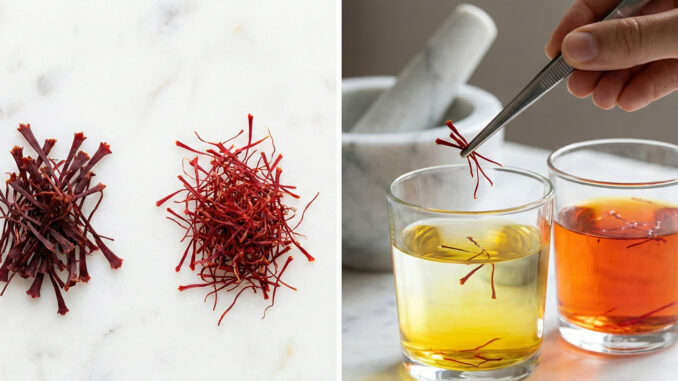
- Kashmiri Saffron (Mogra): This is the rarest variety. Recognized by its dark maroon-purple hue, Kashmiri saffron is widely considered to have the strongest aroma and flavor profile. Unlike Iranian strands, which are long and straight, Kashmiri strands are often shorter and thicker, with a head that looks like a flattened trumpet.
The Water Test: How to Spot a Fake
Unscrupulous sellers are everywhere, even in the souks of Dubai or the markets of Delhi. The only way to be sure of what you are buying is to perform the “Cold Water Test,” a standard method recommended by food safety experts to detect adulteration.
Take two strands of saffron and drop them into a glass of cold water.
- The Color Release: Real saffron releases a beautiful golden-yellow dye slowly. It should take 10-15 minutes to fully color the water. If the water turns red immediately, it is artificial dye.
- The Integrity: After 20 minutes, take the strand out. Real saffron will retain its shape and still look like a stigma. Fake saffron (corn silk or paper) will disintegrate or turn into mush.
- The Smell: Real saffron smells like a mix of hay and honey. It is metallic and pungent. If it smells strictly sweet, it has likely been sprayed with honey to add weight.
Conclusion
Whether you choose the floral notes of Iranian Negin or the pungent punch of Kashmiri Mogra, treat the spice with respect. You only need 3-4 strands to flavor an entire pot of Biryani. Anything more is just showing off.