
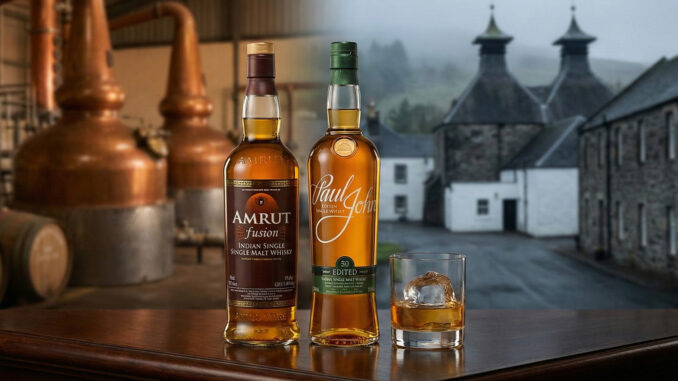
For decades, “Indian Whisky” was a polite euphemism for molasses-based spirits that were technically rum. They were sweet, harsh, and cheap. But in the last 15 years, a quiet revolution has occurred. India is no longer just consuming whisky; it is crafting some of the best Single Malts on the planet.
Brands like Amrut and Paul John are consistently beating 18-year-old Scotches in blind taste tests. The secret isn’t just the barley—it’s the heat.
The Turbo-Charged Maturation
In Scotland, whisky sleeps. In India, it sweats. The intense heat and humidity of Bangalore (Amrut) and Goa (Paul John) accelerate the interaction between the spirit and the oak cask.
This is known as the “Angel’s Share”—the amount of whisky lost to evaporation each year. In Scotland, they lose about 2%. In India, distilleries lose 10-12% annually. This massive evaporation forces the wood flavors into the liquid at a rapid pace. As a result, a 4-year-old Indian Single Malt often has the complexity and depth of a 12-year-old Scotch.
The Big Two
- Amrut Fusion: The bottle that put India on the map. It uses 75% Indian barley and 25% peated Scottish barley. It is rich, oaky, and has a smoke profile that rivals Islay. It was famously named the third-best whisky in the world by critics, shocking the establishment and changing the global perception of Indian spirits forever.
- Paul John Edited: Hailing from the coastal state of Goa, this malt carries a hint of sea salt and tropical fruit. It is softer than Amrut but incredibly complex, often compared to the coastal malts of the Scottish Highlands.
The New World Order
The stigma is gone. Indian single malts are now sold in over 60 countries and are considered luxury collectibles. If you are still drinking Glenfiddich 12 because it’s “safe,” you are missing out on the most exciting whisky region in the world right now.
Next time you are at the club, skip the Scotch. Order a dram from Bangalore. It’s faster, louder, and undeniably Indian.